Wednesday, September 28, 2005

Beyond the High Holidays


The Torah is a God-given guidebook on how to run the race of life.

Continued from previous page

Life may be viewed as a spiritual race. Rosh Hashanah serves as the starting- and finishing- line. The track is littered with all sorts of obstacles and diversions. Your running mate is none other than yourself. … Rosh Hashanah is a time for us to reflect upon how far we are lagging behind our potential. It is a time for us to recognize and analyze our errors; and to plan our strategy for minimizing the gap between who-we-are and who-we-can-be for the following lap to the race.

An obvious question that remains is: Why was the anniversary of the creation of man, rather than the very beginning of Creation (and thus the beginning of time), chosen to be Rosh Hashanah? The answer relates to the very nature of the day described above.

Man is considered by the Torah to be the crown of Creation. Everything else was created to provide man with the environment and tools that enable him to fulfill his purpose in this world. Our sages teach us that man was created last to show that if he lives up to his potential, all else was created for him; but if he does not, he is considered to be so lowly that even a flea was worthy of being created before him.

God created man to express His will in this world. God’s desire and goal is that man should become aware of the duality of his nature; rise above and harness the physical, animalistic part of his being and use its energy to make the physical world more spiritual. The task of a Jew is to transform mundane physical acts and objects into receptacles for spirituality; to reveal that the finite, physical world is not antithetical to Godliness, but can be used as a vehicle to demonstrate God’s infinity and majesty. All of this can be achieved by studying and implementing the Instruction Manual (the Torah), provided by The Creator Himself.

One of the refrains of the moving Rosh Hashanah liturgy is the phrase “Hayom haras olam; Hayom ya’amid bamishpat kol yetsurei olamim.” Roughly translated, this means: “Today is the birthday of the world; today He will judge all the creatures of the worlds.” This in fact is a mistranslation. The word “haras” is more precisely used to refer to gestation (pregnancy) rather than birth. The “birth” or creation of mankind on Rosh Hashanah was really the conception of mankind. God was giving us the potential or the chance to complete our own development process.

It is thus extremely fitting that on the day that God gave mankind the opportunity to achieve greatness, man’s achievement (or lack thereof) is judged and evaluated.

So there you have it. Rosh Hashanah was the beginning of timekeeping for mankind. It was and continues to be the moment when our spiritual stopwatch started ticking, when man was presented with the challenge of his purpose. The shofar that we heard this past Rosh Hashanah sounded the stopping and restarting of that spiritual stopwatch.

As we now move into the year and our race begins, let us consider our mistakes of the past year and plan for the event ahead. Let us take the inspiration from Rosh Hashanah and Yom Kippur, and the spiritual energy of Sukkot, which is approaching, and face the coming event with courage and determination.

This article was originally published in the Jewish Learning Experience’s 2001 newsletter, Vol. 1, No. 1.

To read more articles about Torah, visit the JLE Web site
  • JLE

  • Return to main page to comment on article.
  • Main page
  • Thursday, September 22, 2005

    Cardinals Implicated in Sex Abuse Cover-up

    Continued from previous page

    The grand jury, which met for three years, said that Krol and Bevilacqua transferred the alleged abusers from parish to parish; they failed to notify law enforcement or parishioners of the accusations.

    The Most Rev. Justin Rigali, current head of the archdiocese, issued an apology over the incidents. At the same time, he criticized the grand jury’s findings. “The report is unjustifiably critical of Cardinal Anthony Bevilacqua, Cardinal John Krol and others who worked in the administration of the Archdiocese of Philadelphia,” Rigali stated.

    Rigali’s statement also said: “The number of Archdiocesan priests credibly accused is actually lower than what the report states since the report includes priests who are supervised by either religious orders or another Diocese or Archdiocese, not the Archdiocese of Philadelphia, as well as priests who were deceased at the time of the allegation.”

    The Archdiocese’s official response stated: “Taking unfair advantage of the secrecy and one-sidedness inherent in grand jury proceedings, and focusing upon lurid details of events, the District Attorney’s Office has chosen not to make this report a tool for offering constructive recommendations to prevent sexual abuse of minors in the future. Rather, it focuses on long-ago episodes, and fails to recognize the limited scientific knowledge available in the past about preventing or healing childhood sexual abuse. It also fails to acknowledge any Archdiocesan effort to update its policies consistent with contemporary medical thought.”

    District Attorney Lynne Abraham did not bring charges because Pennsylvania law would not allow her to do so, the Inquirer reported. "Had the law allowed us to arrest or charge or indict people, we would have done so,” she told a press conference.

    To read Washington Post and Philadelphia Inquirer stories, click below:
  • Washington Post

  • Inquirer, “Prosecutors Feel Stymied by Pa. Law”

  • Inquirer, “An ‘Immoral’ Cover-up”

  • Inquirer, “The Grand Jury’s Report on Clergy Abuse”

  • To read Cardinal Rigali’s letter, click below:
  • Letter

  • To read the Archdiocese’s official response, click below. When you reach the page, click on “full text of response” to download a PDF copy.
  • Archdiocese response

  • To read more about the grand jury’s findings, click below:
  • District Attorney’s Office

  • Return to main page to comment on article.
  • Main page
  • Wednesday, September 07, 2005

    Should Jerusalem Temple Be Rebuilt?


    This remnant of Jerusalem's ancient temple, known as the Kotel or Western Wall, is regarded as the holiest site in Judaism./Photo courtesy of Israeli Ministry of Tourism.

    Continued from previous page

    From the Roman Exile until modern times, the Jews believed ourselves to be living under three oaths into which God swore the Jewish people and the Gentile nations. The three oaths are:

    - The Jews will not rise up en masse to the Land of Israel. Individual Jews may visit or settle, but there will not be a mass movement to resettle the Land.

    - the Jews will submit to the yoke of the rule of the Gentile nations.

    - the Gentile nations will not oppress the Jews overmuch.

    What has happened to the three oaths?

    Some ultra-Orthodox sects that oppose Zionism, like the Satmar Hasidim, believe that the three oaths are still in force, and that those Jews who create and live in the State of Israel are sinners. These are a tiny minority of the Jews of today.
    Some Jews would say that the Gentile nations broke the three oaths when they murdered Jews by the millions, and made it difficult for surviving Jews to maintain their identity. When the nations would not refrain from oppressing the Jews the bargain was broken, and the Jews were free to re-establish our sovereign nation.

    Some Jews would say that the three oaths were an unnecessary doctrine which justified the lowly and oppressed status of the Jews for too many centuries of exile. In order for Jews to validate ourselves and seek our universal human rights in the modern world it was necessary for us to repudiate the doctrine that God intends for us to live as second-class subjects.

    What do you think?

    Return to main page to comment on article.
  • Main page
  • Tuesday, September 06, 2005

    New Orleans: A Disaster Waiting to Happen


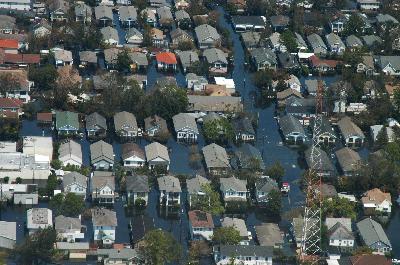
    New Orleans, LA 9/4/05 -- Aerial view of houses in New Orleans swamped by floodwaters after Hurricane Katrina. Photo by: Liz Roll, FEMA

    Continued from previous page

    First, most media outlets and federal officials have reported that 80% of New Orleans is under water. That's an area the size of Manhattan, the Bronx and Brooklyn combined. Most of the major routes for delivering aid and conducting rescues are under water or significantly damaged. And let's not forget that the Katrina disaster area is equivalent to having all of New Jersey, Delaware, Connecticut, Maryland and one of half of Pennsylvania, New York and Virginia (about 90,000 sq. mi. in all) declared disaster areas. As such, some resources moved close to the anticipated disaster area ahead of the storm have been damaged or lost, and some of those who might otherwise pitch in to help, are picking up the pieces in their own communities.

    It is difficult to say how prepared the residents of New Orleans and other coastal areas in the path of Katrina were. However, it is likely that many were not sufficiently prepared. I do not know what level of outreach has been provided over the years to educate the residents in coastal Mississippi, Alabama and Louisiana, but I suspect that more could have been done. But that is true of most areas across the country.

    For example, many areas of New Jersey and New York City are at risk for serious damage associated with a flood surge and winds from a significant hurricane. Yet most residents and commuters are not aware of the hurricane evacuation plans developed for their area. Many do not know what areas are outside the predicted danger zones or where the established hurricane evacuation shelter serving their area is.

    One article, published by the Civil Engineering Magazine in 2003, "The Creeping Storm" by Greg Brouwer provides a useful overview of the history of actions taken over the last 40 years to protect New Orleans. Following Hurricane Betsy in 1965, Congress passed the Flood Control Act, which appropriated funds to increase the height of the levees around the northern side of the city. The U.S. Army Corps of Engineers established a design criteria for the improved levees which is equivalent to a level needed to withstand a fast moving Category 3 hurricane (the Saffir-Simpson scale used to categorize hurricanes did not exist at the time the criteria were set).

    As a result of the 1965 legislation, the system of levees forming a ring around the northern half of the New Orleans to protect it from surging waters in Lake Pontchartrain were set to be completed within the next decade. According to Brouwer, construction of a similar system around the southern half of the city would probably take several more years.

    Yet nearly 40 years after beginning these projects, the Corps was reassessing whether the current height of the levees is sufficient. The levee system was designed for a fast-moving Category 3 storm, based on rudimentary models available in the 1960s. Brouwer states that larger storms or a slow-moving Category 3 storm could potentially overtop the levees, leaving New Orleans under 20 feet of water. Exacerbating the problem is the fact that the coastline has been subsiding over the last 40 years, and protective coastal marsh that would absorb some of the impact of a hurricane is only half as wide as it was when the levees were designed. According to Brouwer, experts said a flood likely with a Category 4 or 5 hurricane would probably shut down the city's power plants and water and sewage treatment plants and could even take out its drainage system. The American Red Cross estimated that between 25,000 and 100,000 people would die in this scenario. Today, the answer is painfully clear: the levee height was not sufficient.

    Even when risks are known, the pace of bureaucratic action is slow and halting. In his article, Brouwer reports, according to Al Naomi, the Corps Project Manager: "Any concerted effort to protect the city from a storm of Category 4 or 5 will probably take 30 years to complete." According to Brouwer's article, the feasibility study alone would have cost as much as $8 million. Even though Congress had authorized the feasibility study, funding had not yet been appropriated. When funds were made available, the study would take about six years to complete. Beyond the studies, there would be many more steps to complete designs and begin, much less complete construction.

    The political will and public interest to commit the time and money to such projects before a disaster are often lacking, even when the risks are great. Is it an election year? Does the project have popular support? These are the considerations that often drive decisions; not need, not risk, not who's at risk, their annual income or skin color. This lack of interest until disaster hits is seen over and over again--close to home and farther away.

    Funding to repair aging dams in New Jersey was largely eliminated until five dams breached during heavy flooding a year or so ago causing significant impact to residents downstream. After the fact, funding was immediately restored. Hundreds of millions of dollars were appropriated for protection of the New York/New Jersey transit system; yet little of it was spent prior to the bombings in London. There are similar examples across the country where important projects, that may save lives, languish.

    Has the response fallen short of what was needed? Have people suffered unimaginable losses? Have people died waiting to be rescued? Absolutely! Is it helpful to the victims to spin the disaster to make a political point, to wrangle over what party is at fault? Is it helpful to cry racism? Absolutely not!

    Return to main page to comment on article.
  • Main page

  • To read the 2003 Civil Engineering Magazine article, click below:
  • Civil Engineering
  • Monday, September 05, 2005

    Where is God When Disaster Strikes?


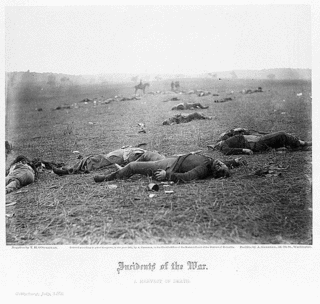
    Suffering is nothing new to the human condition. During the Battle of Gettysburg, Pa., the Union and Confederate armies sustained 50,000 casualities; 7,000 thousand soldiers died. Above, "Harvest of Death," a photo by Timothy O'Sullivan, documents the battle's toll.

    Continued from previous page

    The Bible tells of Job, the good man who was unfairly and severely afflicted, losing children and property and nearly his life, Job rails at God and says “Why me? Why this?”

    God responds and the divine voice is dripping with sarcasm.

    "Who is this,” he says to Job, “that darkens counsel by words without knowledge? Gird up your loins like a man, I will question you, and you shall declare to me.”

    Then God asks whether it was Job who “laid the foundation of the earth?” God asks “Have you commanded the morning since your days began, and caused the dawn to know its place?”

    “Have you entered into the springs of the sea, or walked in the recesses of the deep? Have the gates of death been revealed to you, or have you seen the gates of deep darkness? Have you comprehended the expanse of the earth? Declare, if you know all this.”

    In short, the answer is: Who are you to ask such things?

    To some that sounds harsh: but to those who understand the relationship between the Creator and the creation, it is not. God rightly reminds us that we do not know everything, nor are we entitled to know everything.

    Every time a natural disaster strikes, we learn that creation operates according to a design and that God rarely tinkers with the design. The sun rises and sets. Seasons come and go. Storms form--according to the physical principles of the world--and oftimes they do damage. That’s the way the world works.

    We must also take our own responsibility for human suffering. New Orleans was built 25 feet below sea level and over the last 200 years never developed an adequate means of dealing with a major storm, which everyone knew would eventually come.

    God weeps and suffers with us when we do foolish things. And that God inspires us--if we listen--to help one another recover and not to do foolish things again.

    We are now swamped with horrible images from the Gulf Coast. The news tells us of both the bravery and cruelty of our fellow human beings. In the weeks ahead, we will have to be loving and sharing to those who suffer, whatever the cause.

    But it is not too soon to look at the bigger questions of disaster and suffering. We are nearing Sept. 11, a time to remember another kind of disaster and suffering.

    Many still say the world “changed” that Tuesday morning when the planes attacked New York and Washington. Perhaps our part of the world did, perhaps not.

    But “the world” is the same--filed with people capable of great good and horrendous evil. What has changed is that disaster and suffering came closer to us.

    Others--in Northern Ireland and Israel for example--have lived with terrorism for many years. Others--in the Balkans or Central Africa, for example--have never known a world without terrible religious, racial or ethnic strife. Millions in Africa have died in civil wars and AIDS epidemics in the past eight years while the world did nothing and the United States blocked some efforts to bring relief.

    A few days after that awful September 11, I was at Congregation Shomrei Torah in Wayne, N.J., a conservative Jewish synagogue.

    About 30 men wrapped themselves in their prayer shawls and prayed the ancient prayers. The rituals of Conservative Judaism are rigid; you don’t fiddle with them just to suit the moment. And the prayers that day were about praising God, blessing God’s name, honoring God. They thanked God for calling them into the covenant with God; they thanked God for the Torah, and they remembered the ancestors--Abraham, Isaac, Jacob, Moses. They thanked God for giving them the victory. Here were the ancient people of Israel, beset on every side by enemies, still praising God.

    In New Orleans and Mississippi on Sunday, people of faith gathered to worship, give thanks to God and praise God in the midst of their suffering.

    It helps to put the horrifying events of our world into a historical perspective. When a terror strikes our land or close to us it seems particularly awful because it affects us personally. That’s because in this land we have been complacent and so blessedly free of such things.

    Most of the catastrophes of the world have nothing to do with floods or hurricanes, but with our abuse of our humanity and the evils we perpetrate upon one another.

    The first great terror to strike Christians was the Roman persecutions when believers in Jesus were tortured or put to death. We romanticize that as a time of glorious saints; but the people suffering probably didn’t see it that way.

    Let’s skip around in history and see how suffering is not a new thing.

    The armies of the first Crusade in the 11th Century reached Jerusalem and slaughtered thousands of Muslims and Jews. One eyewitness said the streets literally ran with blood, up to the knees of the horses. This witness thought that was glorious because it was the blood of the “unbelievers.”

    A couple of hundred years later, a peasant boy in Germany envisioned a “children’s crusade.” Perhaps as many as 20,000 children set out to rescue the Holy Land. Thousands perished and the crusade never reached its goal. In Egypt most of them were sold into slavery.

    Let us not forget the torturing and burning of heretics - in the name of Jesus, of course--by the Spanish inquisition beginning in the 13th century.

    The list goes on:

    *France, August 24, 1572 and the days following: Perhaps as many as 50,000 Protestants were killed by troops loyal to a Catholic monarch.

    *France, 1793: The “reign of terror” begins, with torture and the guillotine being the chief instruments of government.

    To come closer to our time:

    *Georgia, 1838: The United States forcibly relocates the Cherokee tribes to Indian Territory (now Oklahoma). More than 4,000 die along the way in the trek known as the Trail of Tears.

    *Gettysburg, 1863: 50,000 casualties in three days.

    *Verdun, 1916: A ten-mile front in the war in Europe sustains 700,000 casualties in eight months.

    What a sad list it could be--the Lusitania, Bataan death march, Soviet Gulag, and more.

    We can hope that these awful events and the catastrophes of our time would lead us to offer more prayers, more witness to peace, more pleas for friendship among all humankind. Believers dare to hope that--because God is gracious and sends grace to us--we can learn to be gracious to others.

    A natural disaster may destroy property, may even kill; but it does not destroy our ability to be caring and gracious. Sometimes, it brings out our generosity.

    Where is God in human suffering?

    The answer lies not with God, but with us.

    We are God’s eyes and hands and voice who must bring God’s grace into the work and help the sick recover. It is our words, our acts as individuals and as a nation that does this. Christian faith calls upon believers to show the world what it means to follow Jesus and to bring healing.

    If anything gets in the way of that mission--internationally, nationally or locally--then there will be more suffering, more loss.

    There will have to be national programs of relief; and we have the capacity to create them. Are we distracted by an international war that is going badly? Are the institutions of our national government maybe captive to forces with their own, non-humanitarian agendas?

    In any struggle to relieve human suffering, whether caused by natural or man-made disasters, God is with us. That is, God wants to be with us, especially as we try to protect and save those who are poor and needy. Sometimes greed, national pride, political chicanery or apathy obstructs the grace of God.

    Christians are to pray for the poor and needy, provide what help they can as individuals and to work in society--by any peaceful means--to help nations get their priorities straight.

    God has promised to be with us, providing grace and love and comfort and strength. Can we--as individuals and a society--act accordingly?

    Return to main page to comment on article.
  • Main page
  • Friday, August 19, 2005

    Torah Talk is the Best Form of Interaction


    Continued from previous page

    Those who have not tried Torah study might think that one needs to be a Torah nerd or a religion nerd or a mighty intellectual to enjoy learning Torah. The truth of the matter is that Torah study is an easy door into pleasant and gratifying social interaction with other people. Take it from Moses, who was a socially awkward loner before the giving of the Torah, but who became gratifyingly involved with 600,000 other people through the gift of Torah.

    Here are some forms of conversation that do not give pleasure to the soul: malicious gossip, empty chit-chat, socially stratifying posing, talk merely to fill time and relieve boredom.

    Such talk leaves one feeling empty and lonely; it creates distance rather than intimacy.

    But a good conversation on a Torah topic is pleasant and gratifying because it is never just about the book itself; Torah conversation is always about important issues of life and spirit. When you engage in a Torah conversation you reveal your inner depths to another person, you are truly heard, and that other person reveals his or her own inner depths to you. You enter into a genuine relationship with another human being. That is the purpose for which human beings possess the power of speech. When that purpose is fulfilled, we feel fulfilled.

    For centuries, Jewish men passed their spare time in the Beit Midrash, the study-house, engaging in Torah discussion. They did so not only to build their minds and improve their virtues; they attended the study-house for a gratifying social experience. (Regrettably, until recent times women were excluded from this experience.)

    The human soul yearns to know and be known by other human beings. Nothing is so pleasant as a meaningful social interaction with another person. Torah opens up the human mouth, and also the ears and the heart - for speaking, for listening, for mutual understanding.

    Return to main page to comment on article.
  • Main page
  • Monday, August 08, 2005

    Pro-life Group Targets Planned Parenthood Donors

    Continued from previous page

    Planned Parenthood, which has corporate offices in New York City, has clinics throughout the country. These clinics offer gynecological services, birth control, HIV testing, infertility screening, pre-natal care, adoption counseling, and abortion referrals. The group’s position on abortion states: “It is the policy of Planned Parenthood Federation of America to ensure that women have the right to seek and obtain medically safe, legal abortions under dignified conditions and at reasonable cost.”

    Return to main page to comment on article.
  • Main page

  • To read the LifeNews story, click below:
  • LifeNews

  • To read about Life Decisions International, click below:
  • Life Decisions

  • To read more about Planned Parenthood’s mission, click below:
  • Planned Parenthood

  • To read the Women’s eNews report, click below:
  • Women’s eNews

  • To visit the Women’s eNews Home Page, click below:
  • Women’s eNews Home Page
  • Sunday, August 07, 2005

    Counselor Has Misgivings About “Brat Camp”

    Continued from previous page

    As a licensed professional counselor (who loves nature and all it holds), I feel that these teens would be better off in a program where they see the reality of poverty in the world, where they could feed the hungry and listen to those in impoverished countries that are under the control of misdirected and/or selfish adults. One teen refused to buy expensive sneakers because he knew kids in sweat factories made them.

    I believe real situations bring real self-esteem, self-worth and real attitude changes as priorities are put in real order.
    As a former brat, I didn't have to have my parents pay $10,000+ to put me in a program to listen to adults I didn't know and respect. I learned from real life experiences that changed me from within.

    I question the ethics of this program, it seems to use superficial means to make superficial changes (and a TV show).
    By imitating and misusing the rituals and using symbols that have deep roots and meaning to others, only proves that this program is not only culturally insensitive but is also unethical. We need to teach respect for all people and their cultures and this "therapy" seems to be breaking the rules.

    Our youth need reality checks, not more meaningless activity. Real self-esteem comes from helping the poor and the exploited.

    I hope this program ends and the producers and therapists will come up with something more genuine, selfless and ethical to teach respect and true self-worth for the teens and the authority figures. Maybe we'll have a more sensitive generation for others who in turn will teach by example and not be filmed by a TV program.

    Return to main page to comment on article.
  • Main page

  • Read original "“Brat Camp" posting.
  • "Brat Camp"
  • Friday, August 05, 2005

    ABC’s “Brat Camp” Misuses Native American Spirituality


    Above, the real Geronimo (left) vs. Chuck Connors as the Apache warrior in the 1962 movie "Geronimo." The real Connors, right, with blond hair and blue eyes.

    Continued from previous page

    For non-viewers, “Brat Camp” focuses on nine troubled teens going through Sagewalk, a wilderness program in the high desert of central Oregon. The kids are taught wilderness skills and given psychotherapy. The goal is to help them to handle life’s difficulties in healthy ways.

    I’m not qualified to comment on the validity of Sagewalk's program.

    But I do have a beef when a group of white instructors put white campers through a faux, hodgepodge Native American naming ceremony.

    I should have seen it coming. Every instructor (all white folks all as far as I can tell) has a faux Native American name – like Glacier, Aspen, and Fire Shaper. For some of the time, the students live in a teepee.

    On Aug. 3’s 9 p.m. episode, the campers completed three days of solo camping. To mark this occasion, they stand around a fire, daub their faces with paint, and receive an “Earth name.” One of the instructors plays a Native American flute as the “mystical ritual” goes on.

    At this point, I feel like I am watching the Caucasian, blue-eyed Chuck Connors painting up in brown face to play Geronimo. Holy ta-tonka! What in the name of Kevin Costner is going on?

    If you’re going to do Native American religion, do it right. Not every Amerindian group is the same. Languages, customs, and religions differ. The tribes of the high Oregon desert are the Paiutes, Yahuskin, and Yapadika. Did anyone at Sagewalk think of contacting one of these tribes and finding out about their heritage. Is a local Native American religious teacher available? How about learning the ethical practices that go along with the rituals?

    Why do that when you can paint your face and play dress-up Indian based on your multiple viewings of “Dances With Wolves”?

    Imagine a group that knows nothing about Catholicism other than what is available through popular culture. They decide that the Mass is a cool ritual. So they do their best to go through the motions of a Mass. One of them may even dress up as a priest.

    What have they accomplished?

    People engaging in such a ritual will have learned nothing about Catholic life, beliefs, morals, hierarchy, and history.

    As an Oklahoman, I know that Amerindian groups are as varied from one another as are people of European descent. How different is a Frenchman is from an Italian or a Pole is from a Greek? Yes, all are Europeans. But there is no generic "European" you can imitate with any authenticity. And what would be the point of doing so?

    For those who are unaware, here's a news flash -- playing dress-up Indian is no longer cool. If you don't believe me, consider this recent action by the NCAA. The athletic organization announced Aug. 5, 2005, that it would ban hostile and abusive American Indian names from post-season tournaments, the Associated Press reported. Starting in February, phony Indian mascots will no longer be allowed to perform in post-season games. Ethnically offensive nicknames and logos will be banned. And by 2008, band members and cheerleaders cannot wear images of American Indians on their uniforms.

    Note to Sagewalk: Playing a flute and calling yourself Squatting Elk or Soaring Hawk does not make you an Indian. It makes you a white person playing dress-up. And if you want these kids to be confident in themselves, try setting an example by being who you really are.

    Return to main page to comment on article.
  • Main page

  • Native American complaints about rituals being hijacked by non-Indians
  • Complaints

  • ABC's “Brat Camp”

  • Sagewalk
  • Sunday, July 31, 2005

    Demonizing the Enemy Subverts Peace Process


    Continued from previous page

    LESSON:
    When you demonize your enemy you only hurt yourself. It is important to our own souls and our healthy society that we remember that our enemies are individuals, and not a nameless mass of devils. Even amongst the enemy nation, like the Moabites to ancient Israel, there might reside in their midst a friend, a potential ally, a person absolutely necessary to our own bright future, as Ruth among the Moabites.

    Former Israeli Prime Minister Yitzhak Rabin was fond of stating publicly that “our enemy are the terrorists, not the Palestinian people.” This perspective is essential to peace-making, which in turn is essential to the security of Israel and the happiness of her Jewish inhabitants. Current Prime Minister Ariel Sharon, to his credit, has taken a similarly pragmatic approach, attempting to separate terrorists from the Palestinian masses.

    Americans must also remember that our enemy is not “the Arabs” nor “the Muslims”, but only those promoting a particular brand of radical Islam and those who promote terrorism as a tool in an apocalyptic war against the West. It is true that there are not enough loud voices in the Islamic world protesting terrorism, but there are such voices, and we must do what we can to strengthen them. One tool in weakening the voice of hatred and strengthening the voice of moderation is for us to be willing to distinguish between persons and not brand an entire nation, people or religion as hopelessly irredeemable. Hope for the future breeds compromise, tolerance and peace.

    Stephen M. Wylen is the author of numerous books, including "The Seventy Faces of Torah: The Jewish Way of Reading the Sacred Scriptures."

    Return to main page to comment on article.

  • Main page
  • Saturday, July 30, 2005

    International Slave Trade – Where’s the Outrage?


    Continued from previous page

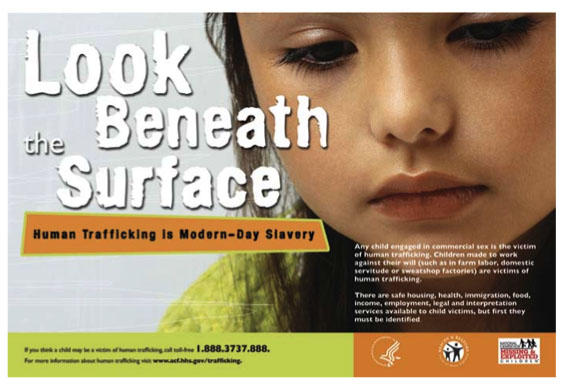
    Slavery takes many forms throughout the world. In some poor countries, people sell themselves into slavery in hopes of getting out of debt, using themselves as collateral. In other case, parents sell their own children. These children wind up in a variety of jobs-- including making carpets in Pakistan, rolling cigarettes in India, harvesting cocoa in western Africa, and serving as jockeys for camel races in the United Arab Emirates. Roughly 2 million child slaves—some as young as five--are forced into prostitution. So-called sex tourists travel to countries where child prostitution is prevalent and tacitly condoned. These countries include Thailand, Cambodia, Costa Rica, and Brazil.

    In the U.S. and elsewhere, the public is outraged when children are molested and exploited, when workers are underpaid and endangered. And this is only fair and right. And many faith communities and humanitarian organizations have issued statements condemning human trafficking.

    But where is the average person's outrage for the poor souls living in chains? Where is my outrage? Where is yours?

    U.S. government hot line on human trafficking: (888) 373-3888.

    Return to main page to comment on article.
  • Main page

  • To find out more, visit these Web sites:
  • World Vision

  • Iabolish.org

  • Anti-Slavery International

  • Newark Archbishop John J. Myers' statement on human trafficking

  • U.S. government Web site for victims of slavery
  • Monday, July 25, 2005

    Peace Comes From the Almighty, Not From Humanity


    Continued from previous page
    The Torah sometimes jars us into re-evaluating our core values. The attainment of peace seems to be a universal human desire. What subtends this longing for peace?

    For many, Peace is an El Dorado, beckoning seductively with promises of freedom to pursue selfish agendas. It releases those bound to G-d with chains of needy prayer. Once there is peace of mind, does the mind yet have a place for G-d?

    Our generation, in a fit of amnesia, seeks to achieve “peace in our time.” Many alchemist-diplomats and politicians and world bodies attempt to synthesize peace by simply ignoring evil, by signing agreements with the devil, by hoping against hope that the heartless will have a change of heart. They feed the beast, celebrating as a great achievement moments of quiescence, as the beast sharpens its claws.

    As we have witnessed recently, those who turned a blind eye to the terror massacres in Israel and made excuses for the “oppressed” killers, those who tolerated the most virulent proponents of this toxic philosophy, trusting that their hospitality would purchase immunity, have finally been struck by the viper nesting in their midst.

    The Hebrew word for peace, “shalom”, is derived from the root SH-L-M which means “whole” or “complete.” It is the natural state of existence when equilibrium is attained in the universe. The entropy created by man’s evil acts, disrupts and unsettles this natural order, creating mayhem.

    Peace does not flower as a result of man’s contrivances. We pray daily that the One who makes peace in the celestial universe will make peace for us (“Oseh Shalom…”).

    True peace is a product of Divine origin. Man can facilitate the production of peace, not by performing cosmetic surgery on evil, but by eradicating it in toto. Remaining faithful to Torah values, even when they are not valued by social currency, will ultimately create a climate of cosmic order, a worthy resting place for the ultimate blessing of true peace.

    Return to main page to comment on article.
  • Main page

  • To read other Torah Thoughts, please visit the Jewish Learning Experience (JLE) Web site:
  • JLE
  • Tuesday, July 19, 2005

    Islamic Court Condemns Gay Nigerian to Death


    References: Traditional condemnations of homosexuality

    Judaism and Christianity

    Leviticus 20:13 (New International Version): " 'If a man lies with a man as one lies with a woman, both of them have done what is detestable. They must be put to death; their blood will be on their own heads.’”

    Christianity

    Romans 1:27 (NIV): “In the same way the men also abandoned natural relations with women and were inflamed with lust for one another. Men committed indecent acts with other men, and received in themselves the due penalty for their perversion.”

    1 Corinthians 6:9-10 (NIV): “Do you not know that the wicked will not inherit the kingdom of God? Do not be deceived: Neither the sexually immoral nor idolaters nor adulterers nor male prostitutes nor homosexual offenders nor thieves nor the greedy nor drunkards nor slanderers nor swindlers will inherit the kingdom of God.”

    Catechism of the Catholic Church, 2357: “Basing itself on Sacred Scripture, which presents homosexual acts as acts of grave depravity, tradition has always declared that ‘homosexual acts are intrinsically disordered.’ They are contrary to the natural law. … Under no circumstances can they be approved.”

    Islam
    Yusuf Ali translation of the Quran: 7:80-81: We also (sent) Lut [Lot]: He said to his people: "Do ye commit lewdness such as no people in creation (ever) committed before you?

    "For ye practise your lusts on men in preference to women : ye are indeed a people transgressing beyond bounds."

    Sayings of Mohammed (Ahadith):
    If you find anyone doing as Lot's people did*, kill the one who does it and the one to whom it is done.
    (Tirmidhi, Ibn Majah).
    (Sayings of Muhammad by Prof. Ghazi Ahmad).

    *In Genesis 19:3-5, the men of Sodom attempted homosexual rape on Lot’s guests, who were messengers from God.

    Return to main page to comment on article.

  • Main page
  • Sunday, July 17, 2005

    Students Should Be Taught "a Lot of Science"


    Continued from previous page

    The “agreed upon standards” are a part of the 2001 No Child Left Behind Act which states that “a quality science education should prepare students to distinguish the data and testable theories of science from religious or philosophical claims that are made in the name of science. Where topics are taught that may generate controversy (such as biological evolution), the curriculum should help students to understand the full range of scientific views that exist, why such topics may generate controversy, and how scientific discoveries can profoundly affect society.”

    The uproar from Saint Darwin’s ardent defenders was predictable. None was willing to participate in the public hearings held in early May.

    Yet a new national survey shows that almost two-thirds of U.S. adults (64%) agree with the basic tenet of creationism, that “human beings were created directly by God.” Another 10 percent subscribe to the theory that “human beings are so complex that they required a powerful force or intelligent being to help create them” (intelligent design). Moreover, “a majority (55%) believe that all three of these theories [evolution, creationism and intelligent design] should be taught in public schools.”

    Such open-mindedness is in keeping with the findings of fact that came out of the hearings in Kansas; “An objective approach to teaching origins science is one that reasonably informs students about relevant competing scientific views. State endorsement of an objective approach that favors neither Naturalistic Explanations [n]or the Scientific Criticism of those Explanations will more appropriately inform students about origins, will provide good and liberal science education, will cause the state to not take sides on the issue, and is a formula that is most likely [to] lead to the best and religiously neutral origins science education.”

    Why does the mere mention of objectivity and a critical examination of Darwinian evolution send shudders of fear through its evangelists? And what exactly is it that so fiercely drives them to defend their theory?

    It is clear that there is more than science at work here.

    Darwinism is the core belief under girding philosophical naturalism, expressed in such documents as the Humanist Manifesto III which establishes the Humanist belief system, as “rejecting any ‘supernatural’ influence and rel[ying] on modern science and the view that humans are the product of ‘unguided evolutionary change.’”

    In a similar vein one could cite George Gaylord Simpson: “Man is the result of a purposeless and natural process that did not have him in mind,” or Jacques Monod, “Man has to understand that he is a mere accident.” Monod is typical of the origins exclusionists, writing that Darwinism was “…no longer one among other possible or even conceivable hypotheses. It is today the sole conceivable hypothesis, the only one that squares with observed and tested fact. And nothing warrants the supposition—or the hope—that on this score our position is likely to be revised.”

    Nonetheless, most aren’t buying that brand of religion.

    In large numbers, we remain intractable in our belief that a supreme being was the ultimate cause behind the creation of the universe; that there was a first “unmoved mover,” a creator or an intelligent designer and that all we call reality did not happen by random, naturalistic phenomena.

    Paul the apostle was just as ardent in his beliefs as modern-day Darwinists. In describing the natural world he explained that belief in an intelligent designer was a priori: “His invisible attributes are clearly seen, being understood by the things that are made...”

    The 16th-century scientist Francis Bacon wrote, “A little science estranges a man from God. A lot of science brings him back.” Clearly, this is what is at the heart of Darwinist’s fears of the teaching of “a lot of science.”

    Gregory J. Rummo has a master's degree in organic chemistry from Fordham University. His column appears Sundays on the editorial page of the New Jersey Herald.

    Return to main page to comment on article.

  • Main page
  • Friday, July 15, 2005

    Catholic Urges Compassion for Animals


    Continued from previous page

    The 11th century Rabbi Shlomo Itzchaki (also known as RASHI) and other rabbinic commentators give some insight. Rashi says "there is in this expression v'yirdu the meaning of dominion and the meaning of subservience. If he (man) is found worthy, he has dominion over the beasts and cattle. If he is not found worthy, he becomes subservient before them and the beast rules over him."

    In 1984, Bible scholar Claus Westermann stated: "...dominion over the animals cannot mean killing them for food. ... Dominion over the animals certainly does not mean their exploitation by humans. People would forfeit their kingly role among the living were the animals to be made the object of their whim."

    How does a faith community interpret “dominion” today? What does it mean to 'rule over' in the context of Genesis 1 before humans became disobedient? How should we 'rule over' God's creation?

    If we believe that animals suffer horribly in factory farms and if we believe that we support their abuse with the money entrusted to us (or make money serving them as food), if we believe greed and gluttony are sins, then our generalizations to rationalize God's approval about eating meat (even if God is thanked for their lives of torture and is asked for His blessing on them), then I believe it's a sin of ignorance or indifference.

    Aren't we to glorify God in everything we do and say or at least try to if we truly love God and others? Unfortunately our seminaries and church leaders don't include in their dialogues the billions of animals that suffer daily while creationism and evolution are still being discussed (Darwin himself questioned his own theory), rather than the morality of the food we put in our mouths on a daily basis?

    We would do well do read Amos 6:3-4 and Numbers 11 to get an idea of God's thoughts. The old song 'Let peace begin with me' has some truth to teach us as we begin to thank God and Jesus, the Prince of Peace, for what we eat. Are we going to believe The Way, The Truth, and The Life, or the Father of Lies, who has been deceiving us for centuries? Being made in God's image, let's strive to be compassionate children and true followers of Jesus.

    Return to main page to comment on article.

  • Main page
  • The Unleavened Imagination


    Continued from previous page
    Another way of phrasing the question is: Who are we loyal to – our selves, our family, our tribe? And is writing an inevitable betrayal?

    People write out of love and out of anger. Who is more loyal than the angry son or daughter? Could Roth and Englander be the loyal opposition?

    And yet how easy it would be for us to say and write and reveal all.

    I have felt in the late hours of the night the incredible power of saying and writing everything that could be said, only to throw it away (and deprive my audience?) in the morning. It can be oddly freeing to write with restrictions. Some of the most profound poems and books have been written for children. And everyone knows children can’t be shown and told everything. It would be harmful.

    The relationship between an audience, society, culture and the inner imagination of the writer is dynamic. The elements are forever shaping each other.

    Imagine what it would be like to cook without salt. And yet baking without yeast yielded matza, the bread of freedom (and poverty). A wealth of choices can restrict. Limits paradoxically can free.

    We write from anger and love, and from the impoverishment of our imagination and the wealth of our fantasies.

    Would you tell a story, even if it killed your father – and by father I mean our inheritance, our community, our ancestors, our received traditions? What if it made a good story? What if telling that story (or killing your father) was a way of saving your own life? Would you do it? And what if that story (or killing your father) made you rich and famous? How do we know why people are writing? Can we ever know?

    Somehow this all reminds me of Hawthorne’s “The Birthmark.” Hawthorne, of course a religious man, knew well to wander in the spaces between greed and virtue, perfection and beauty. A scientist wanted to rid his beloved of the one imperfection – a birthmark on her cheek. Having found the right formula, he succeeded in dissolving the mark, only to watch her life ebb and disappear. In our quest for perfection in art, we are in danger. Saying it all, revealing it all, may be killing it all. And in our quest for complete loyalty to religion, we may be killing religion, too. If we’re not disloyal, can we ever be loyal? There would be no loyalty without a taste of disloyalty.

    Maybe we really need to kill our fathers to tell the story, because telling the story is ultimately what keeps us all alive.

    Ask the fathers what they think. How should we approach them? What should we do? What should we say?

    “Ask your father and he will tell you…” (Deut. 32:7) After all, they had fathers, too. They told a story, and yet they were able to keep their own fathers alive.

    Ruchama King is the author of “Seven Blessings” (St. Martin’s Press), a novel about love and faith in Jerusalem. This article originally appeared in The Jewish Week.

  • The Jewish Week


  • Return to main page to comment on article.

  • Main page
  • Tripping Over Jefferson's "Wall of Separation"


    Continued from previous page
    A University of Connecticut Department of Public Policy study found that journalists who were surveyed picked Democrat John Kerry over George Bush in the 2004 election by a margin of over 2-to-1. In another survey, only 12 percent of local reporters, editors, and media executives are self-described conservatives.

    The Christian Science Monitor reported last year on the findings of the non-partisan Pew Research Center which found “the gap between journalists and other Americans particularly wide on social issues.”

    547 journalists and executives in a wide range of print and broadcast organizations were surveyed. 88 percent thought “society should accept homosexuality; about half the general public agrees. And while about 60 percent of Americans say morality and a belief in God are inexorably linked, only 6 percent of national journalists and executives surveyed believe that.”

    Liberal media bias is old news.

    What is news is that lately, this bias has turned ugly and in some cases, downright hostile.

    A newspaper in which my column appears recently dished up an editorial written in response to my column, “Liberals apply double standard when it comes to religion.”

    Entitled “The right is wrong,” the editorial led with a laundry list of complaints: “The religious right wants to outlaw abortion, permanently ban embryonic stem-cell research, require the teaching of creationism in schools and funnel ever-more federal money to religious groups.”

    The hand-wringing continued several paragraphs later as Christians were compared to mullahs desiring a theocracy in America. “But what distinguishes a democracy from a theocracy except the wall dividing church and state?”

    The title of the editorial reminded me of the prophet Isaiah’s words “Woe to those who call… good evil.” That the religious right would like to see the genocide of pre-born humans halted is not news. And raising a race of slaves for the sole purpose of harvesting their body parts should be abhorrent to all but the most barbaric. What is it that evolutionists fear when the teaching of “creationism” (Intelligent Design is a better metaphor) is proposed in public schools? Are evolutionists so insecure in their own religion, which requires its adherents to practice faith in spontaneous generation—a “theory” debunked centuries ago by modern science, that they cannot stand to have their ideas challenged? And why not fund faith-based organizations if indeed they are the most effective in solving the societal problems that continue to plague us?

    If the media wishes to characterize Judeo-Christian influence in American culture as a breach in “the wall of separation,” its members need to go back to school and brush up on their American history. Their hallowed “wall” is not mentioned in any of the founding documents of our country; including the Declaration of Independence, the Constitution and the Bill of Rights.

    The concept of separation of church and state comes from a phrase used by Thomas Jefferson in a private letter written to a group of Baptists in Danbury Connecticut to quell their fears that the First Amendment’s guarantee of free religious expression implied it was a freedom that was only government-given and not God-given.

    Jefferson wrote, “Believing with you that religion is a matter which lies solely between man and his God; that he owes account to none other for his faith or his worship; that the legislative powers of government reach actions only and not opinions, I contemplate with sovereign reverence that act of the whole American people which declared that their legislature should ‘make no law respecting an establishment of religion or prohibiting the free exercise thereof,’ thus building a wall of separation between Church and State. Adhering to this expression of the supreme will of the nation in behalf of the rights of conscience, I shall see with sincere satisfaction the progress of those sentiments which tend to restore to man all his natural rights, convinced he has no natural right in opposition to his social duties.”

    Author and historian David Barton explains, “Jefferson’s reference to ‘natural rights’ invoked an important legal phrase which was part of the rhetoric of that day and which reaffirmed his belief that religious liberties were inalienable rights. While the phrase ‘natural rights’ communicated much to people then, to most citizens today those words mean little. By definition, ‘natural rights’ included ‘that which the Books of the Law and the Gospel do contain.’ That is, ‘natural rights’ incorporated what God Himself had guaranteed to man in the Scriptures. Thus, when Jefferson assured the Baptists that by following their ‘natural rights’ they would violate no social duty, he was affirming to them that the free exercise of religion was their inalienable God-given right and therefore was protected from federal regulation or interference.”

    “Jefferson believed that God, not government, was the Author and Source of our rights and that the government, therefore, was to be prevented from interference with those rights. Very simply, the…‘wall’ of the Danbury letter w[as] not to limit religious activities in public; rather [it] w[as] to limit the power of the government to prohibit or interfere with those expressions.”

    “Thomas Jefferson had no intention of allowing the government to limit, restrict, regulate, or interfere with public religious practices. He believed, along with the other Founders, that the First Amendment had been enacted only to prevent the federal establishment of a national denomination.”

    Jefferson’s intentions were very clear.

    What is not clear is why this must be explained by a businessman moonlighting as a newspaper columnist.

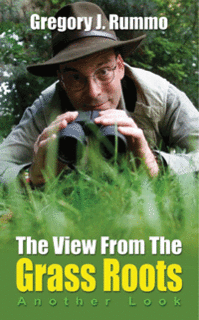
    Gregory J. Rummo is an author and columnist. His second book, “The View from the Grass Roots—Another Look,” is available from amazon.com or the author's website, www.GregRummo.com.
  • GregRummo.com

  • Return to main page to comment on article.
  • Main page
  •